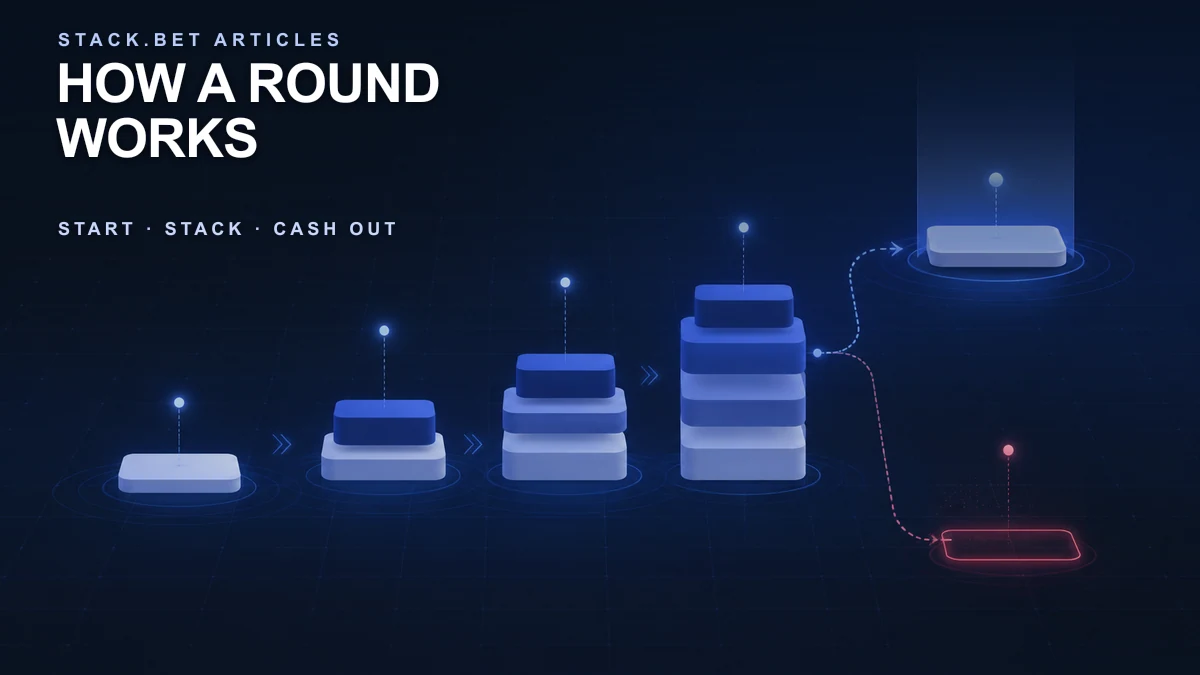
A Stack.bet round is a sequence of placement decisions. You choose a stake, start the moving stack, and try to place one tile at a time. Every accepted tile can increase the multiplier, but it can also bust. You decide whether to continue or request cashout after a surviving placement.
Before the round starts
Stack.bet is a real-money gambling product. Before playing, confirm that you are eligible, that the selected currency is available, and that your stake is within the limits shown in the product. A valid-looking amount in the browser is not enough: the authoritative service still checks the round request, account status, balance, and current game configuration.
Read the game and risk disclosures and decide what you can afford to lose in full. The current risk and multiplier table is available in the How it works section.
Starting the round
When a start request is accepted, the stake is associated with a new round and the game returns the information needed to play it. That includes the round identifier and a cryptographic commitment used for later verification. The underlying server seed remains hidden while the round is active so it cannot be used to preview future random values.
The first tile then begins moving. The visual motion helps you choose when to act, but the final placement result is not decided solely by what one rendered browser frame appears to show. Stack.bet evaluates the accepted input against the authoritative round state.
Placing each tile
Tapping or using the supported placement control sends an intent for the current tile. The game evaluates the authoritative position and returns the resulting offset and grade. The current non-miss grades are Perfect, Great, Good, Okay, and Sloppy; a Miss ends the round.
A non-miss grade means the tile was accepted for outcome evaluation. It does not guarantee survival. Less precise accepted placements add progressively more placement pressure, which can make the current and later steps less forgiving. The detailed calculation is explained in placement grades and bust risk.
How bust risk and multiplier growth interact
Each tile has a configured base bust chance and growth factor. Placement pressure can add to that base chance. If the tile survives, its growth factor is multiplied into the round’s cumulative multiplier; if it busts, the round ends with no cashout amount.
New multiplier = previous multiplier × current tile growth factor
Potential cashout amount = stake × current cumulative multiplier
Base risk generally rises as the stack advances, and placement pressure may raise the actual risk further. The cumulative multiplier can become large because it represents the product of every survived step, not because reaching a high level is likely or guaranteed. See what 0% base house edge means for the base probability and multiplier relationship.
When cashout becomes available
In the current rules, cashout becomes available after the first accepted tile survives. A cashout request asks Stack.bet to end the active round at its current multiplier and settle the resulting amount. It is different from withdrawing funds to an external wallet.
Until that request reaches an authoritative terminal state, treat the displayed figure as a potential amount rather than completed funds. The full lifecycle and first-tile rule are covered in cashout and multipliers.
How a round ends
A round stops through one of these terminal paths:
Cashout: an accepted cashout request ends and settles the round.
Bust: an accepted placement either receives a Miss grade or fails its bust-roll evaluation, and the round amount becomes zero.
Maximum-tile win: surviving the current final tile completes the round as a win.
The current public configuration contains 30 tiles. Rules can change, so use the live product and current public table rather than treating an old screenshot or article example as the active contract. Once a round is complete, its seed proof and stored placements can be checked using the round verification guide.
Before you play
Choose a stake you can afford to lose completely.
Read the next-tile risk and cumulative multiplier together.
Set a cashout point, loss limit, and session limit before the round.
Do not chase a loss or treat a previous outcome as a prediction.
Use a cooldown or stop playing if the session is no longer entertainment.
Learn about limits, cooldowns, and self-exclusion, or visit the Stack.bet FAQ for product questions.
Methodology and change control
This article was reviewed on against the current public game configuration, round commands, placement evaluation, multiplier calculation, cashout rules, and terminal settlement behavior.
It explains the product flow; it does not predict outcomes or provide a winning strategy. If the active round rules change materially, the examples and last-reviewed date must change too.